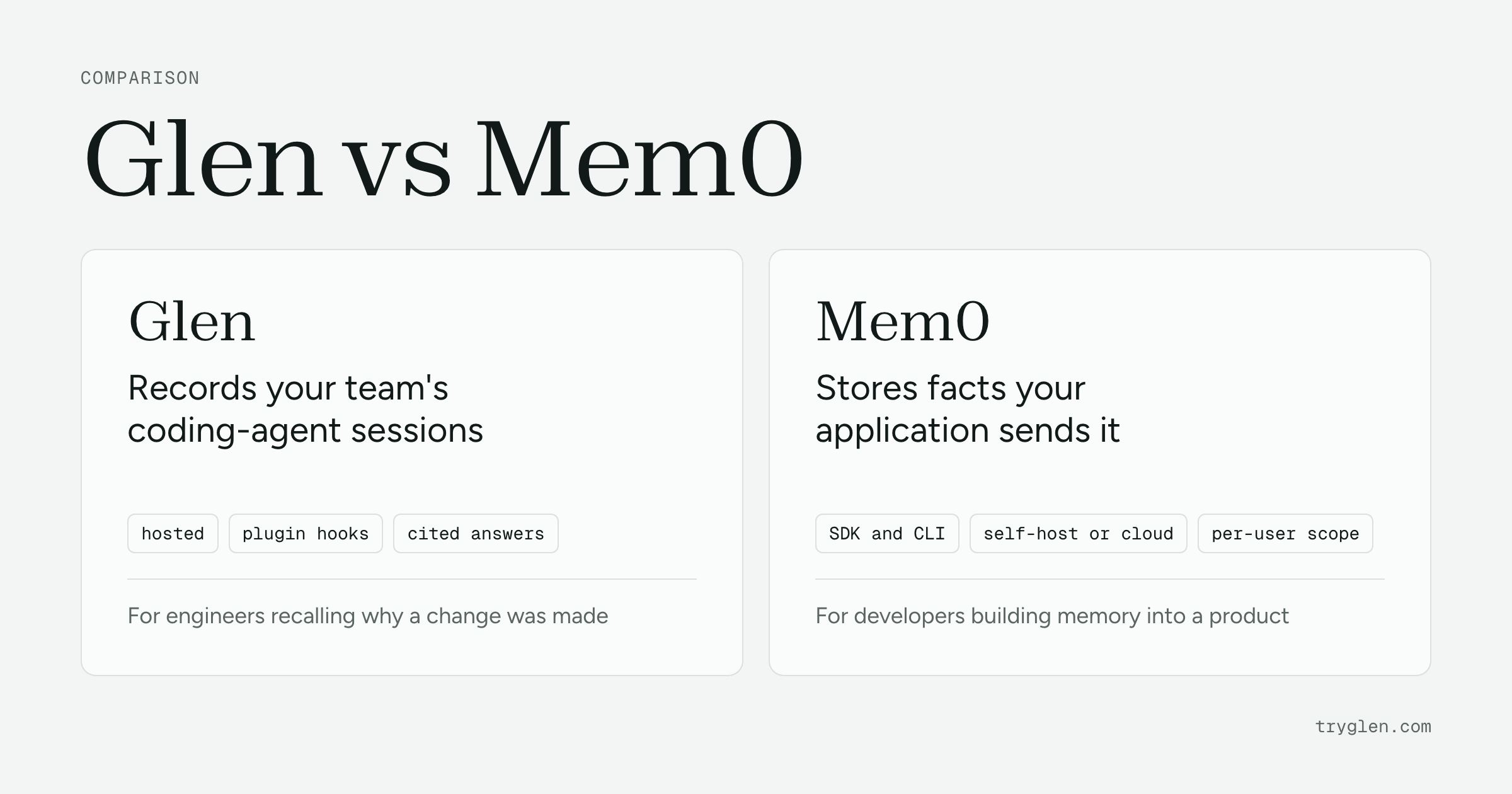
Glen and Mem0 both get described as "memory for AI agents", and they're rarely competing for the same job. Glen records the sessions your team already has with coding agents and makes them searchable by every teammate's agent. Mem0 is a memory layer you call from your own code, usually to remember things about the users of a product you're building.
We make Glen, so this isn't a neutral review. The Mem0 details come from its repository, documentation and pricing page as they read in November 2026, and where Mem0 is the better choice we say so.
Short answer
- Choose Glen if the context you keep losing is in coding-agent sessions: why a build setting changed, what a teammate already tried, which approach was rejected. Glen is hosted, records through plugin hooks, and has no SDK.
- Choose Mem0 if you're building memory into an application, or you need to self-host. You get Python and TypeScript SDKs, a CLI, an Apache 2.0 library and a self-hosted server, and you write the calls that store and retrieve.
- Choose neither if you work alone in one coding agent.
AGENTS.mdand the agent's built-in memory cover standing rules and personal preferences. - Use both if you build an AI product with coding agents. They sit at different layers and don't overlap.
Glen vs Mem0 at a glance
| Glen | Mem0 | |
|---|---|---|
| What it stores | Recorded coding-agent sessions, plus Slack, GitHub and Linear on paid plans | Facts extracted from what your code sends it |
| How context gets in | Plugin hooks record each session | Your code calls add(), or a coding plugin does |
| How it comes back | A hook flags matches in Claude Code, Codex and Pi; other agents search on demand | Your code calls search() and places the results in the prompt |
| Interfaces | Plugins for Claude Code, Codex, Cursor, Pi and Grok Build, a CLI, Slack, a web app and a remote MCP server | Python and TypeScript SDKs, a CLI, coding-agent plugins and skills, a Chrome extension |
| Runs where | Hosted only | Open-source library, self-hosted server, or Mem0's cloud |
| Scoping | Per-memory permissions inherited from the source, checked at recall | user_id, agent_id, app_id and run_id filters you pass |
| Provenance | Answers cite the session, pull request or thread | Extracted facts, with no link back to a transcript |
| Price | Free to 15,000 memories and 3 people, then paid plans | Free with monthly quotas, then custom; self-hosting costs your infrastructure and model calls |
For a row-by-row version, see the Glen vs Mem0 comparison page.
How capture and retrieval work
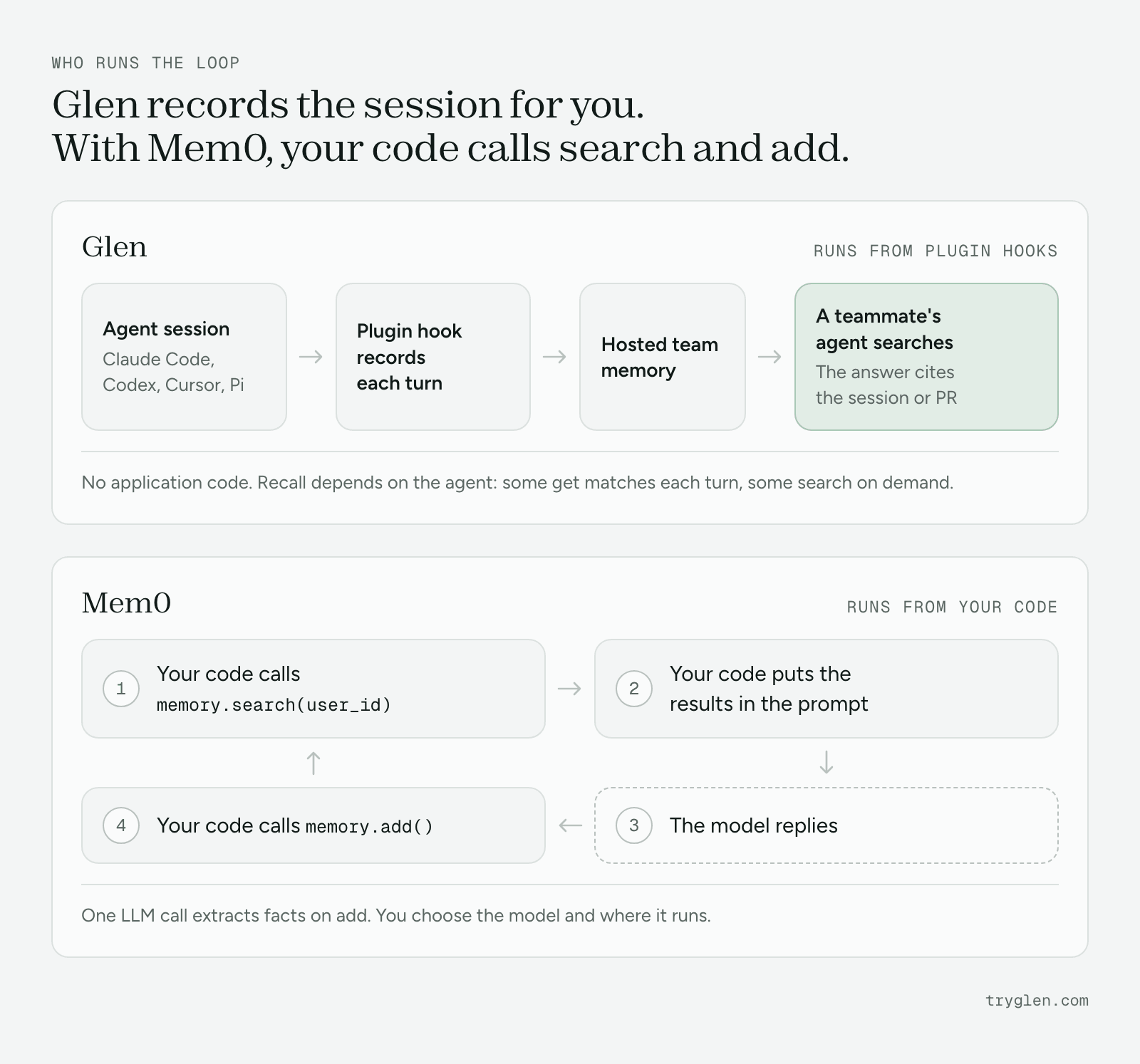
The clearest difference is who runs the loop.
Glen: a CI timeout, traced to a decision
A nightly CI job starts timing out and you ask your coding agent why. This is the illustration on Glen's homepage: the agent's search returns an October 2 thread in #infra about cutting four test shards to two, a teammate's agent session from that week, and pull request #1188. Together they show that timeout-minutes stayed at 20 while the run time climbed to about 31 minutes.
Nobody wrote that down for the agent. The session was recorded by a plugin hook when it happened, the Slack thread and the pull request came in through integrations, and the answer cites all three so you can check it. You wrote no capture code and maintain no index.
How the match reaches the model depends on the agent. In Claude Code, Codex and Pi, a hook checks each prompt and flags matching memory. In Cursor and Grok Build, the agent runs a search when it needs one.
Mem0: a user's preferences, remembered by your application
Your product has an assistant, and it should remember that Alice prefers dark mode and vim keybindings. With Mem0, your code runs the loop shown in its README: call memory.search with Alice's user_id before each model request, put the returned strings in the system prompt, and call memory.add with the conversation after the model replies.
On add, Mem0 makes one LLM call to extract facts. Since the algorithm change its README dates to April 2026, extraction is add-only: memories accumulate and nothing is overwritten. Retrieval combines semantic similarity, BM25 keyword matching and entity matching. The defaults are OpenAI's gpt-5-mini for extraction and text-embedding-3-small for embeddings.
What you get back is compact state about a user, not a record of what was said. That's the right shape for personalisation and the wrong one for "show me the conversation where we decided this".
Decision history versus user facts
Both keep context across sessions. Glen keeps the session and links it to the code it produced, so you can open the reasoning behind a change months later. Mem0 distils interactions into facts under identifiers your code controls, so your software decides what enters each prompt. Neither is a substitute for the other.
Setup and what you own afterwards
Glen's setup is one command. npx @tryglen/cli@latest install detects the coding agents on your machine and installs a plugin for each, and you can import your last 30 days of sessions so recall works on day one. The per-agent setup guide lists what each plugin records. MCP clients such as Claude and ChatGPT connect to the remote MCP server, which searches memory and runs shared skills but records nothing.
After that there's nothing to operate. The one thing to plan for is that recall isn't guaranteed on every prompt, so rules that must always apply stay in AGENTS.md.
Mem0 is more than an SDK, and treating it as one undersells it. Beside pip install mem0ai and npm install mem0ai, the repository ships a CLI (@mem0/cli on npm, mem0-cli on PyPI) with mem0 add and mem0 search, plugin directories for Claude, Codex, Cursor and Kimi, integrations for LangGraph and CrewAI, and a Chrome extension. Its Agent Skills list Claude Code, Codex, Cursor, Windsurf, OpenCode and OpenClaw, and they walk a coding agent through wiring Mem0 into a codebase.
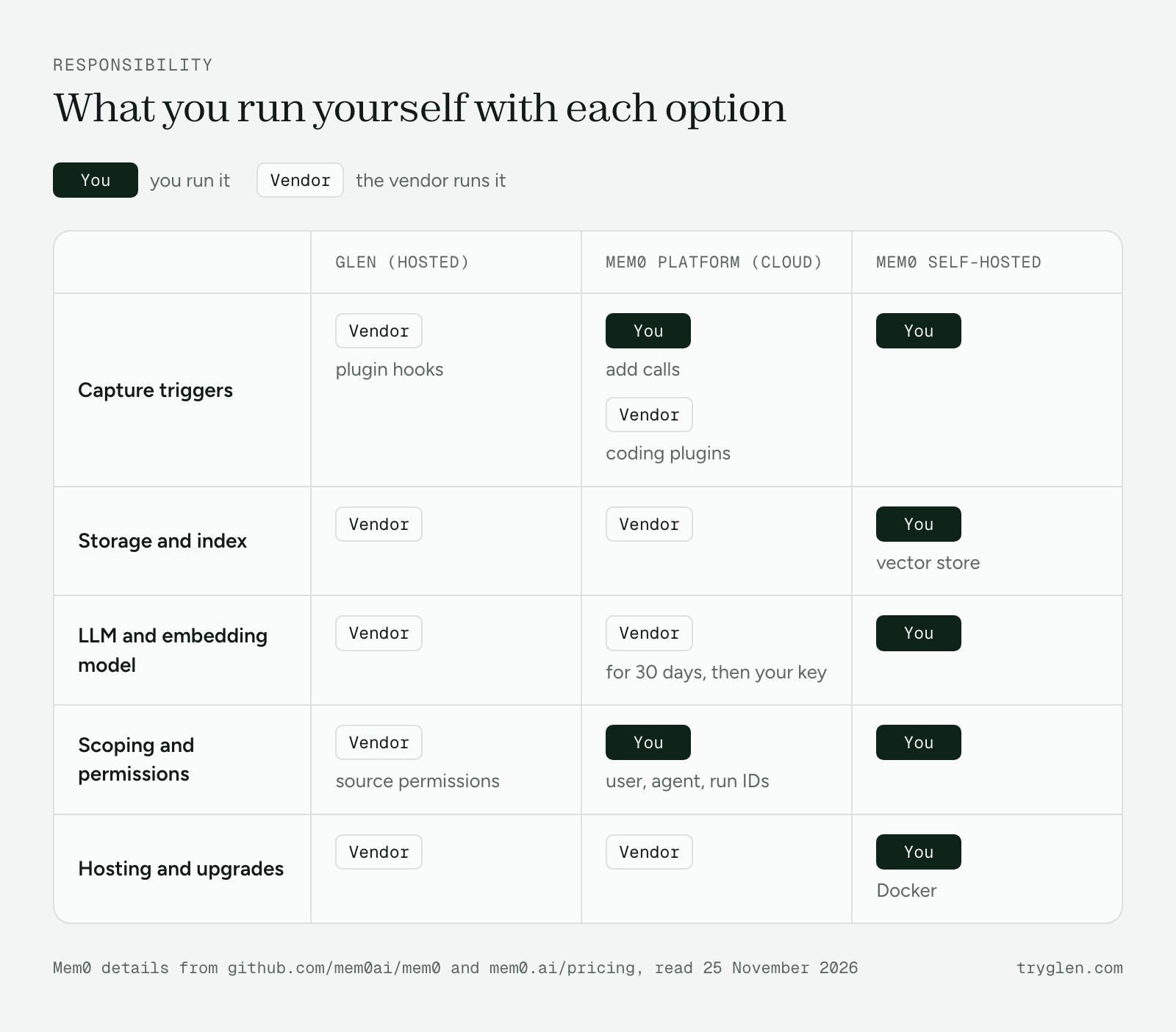
You still own the runtime. Your code calls search and add. On the open-source library or the self-hosted server, you also run the vector store and pay for the LLM and embedding calls.
Sharing, access control and governance
Glen is built around a team seeing each other's work. Teammates can search recorded sessions, and a session can be handed to another agent mid-task with its history. Access is checked per memory at recall: each memory keeps the permissions of its source, and an agent returns only what the person asking is allowed to see. From Slack, Glen reads public channels only, never DMs or private channels.
You can keep a session out of team memory with glen incognito, hide a memory from search with glen forget, and delete your own conversations. Exporting or deleting a whole organization goes through support. The security page covers the rest, including the SOC 2 Type II report Glen is working toward.
If your policy says engineers must not be able to find each other's agent sessions, Glen is the wrong tool. The same goes for a requirement that data stays on infrastructure you run.
Mem0 gives you the infrastructure and leaves the policy to you. The self-hosted server runs in Docker with authentication on by default, through an ADMIN_API_KEY or an admin account created in a setup wizard. Memories are scoped by the identifiers you pass: user_id, agent_id, app_id and run_id. The hosted platform adds organizations and projects with two member roles, reader and owner.
What Mem0 doesn't model is a team of engineers with different access to different sources. There are no per-channel permissions and no link from a fact back to the commit or conversation behind it. If you need those, you build them around Mem0.
Deployment and pricing
Glen is hosted, with no self-hosted build. The free tier covers 15,000 memories for one person or a team of up to three, with no credit card. The Personal plan raises that to 250,000 memories and adds integrations, and the Team plan removes the limits on people and memories.
Mem0's README describes three ways to run it:
| Library | Self-hosted server | Cloud platform | |
|---|---|---|---|
| Setup | pip or npm install | docker compose up | Sign up |
| Dashboard | No | Yes | Yes |
| Auth and API keys | No | Yes, on by default | Yes |
| Advanced features | No | Previews | Included |
The library and server are Apache 2.0. Mem0's pricing page lists two cloud tiers. Free covers unlimited end users with 10,000 adds and 1,000 retrievals a month for the first 30 days, with Mem0 paying for model calls. After that you bring your own LLM key and get 50,000 adds and 10,000 retrievals a month, with usage past the limits billed up to a cap you set. Custom plans add graph memory, SSO, audit logs, an SLA and on-prem deployment.
Self-hosting replaces a subscription with an infrastructure bill: the Docker runtime, a vector store such as Qdrant, and a model call for every extraction.
Why the published benchmarks don't compare
Each vendor publishes numbers, and they measure different things.
Glen's benchmark replayed 100 merged pull requests in a workspace that had used Glen for two months. Codex re-implemented each one with and without team memory, and with memory it used 29% fewer tokens and finished 21% faster. That measures end-to-end coding work in one workspace.
Mem0's README reports conversational recall: 92.5 on LoCoMo, 94.4 on LongMemEval, and 64.1 and 48.6 on BEAM at one million and ten million tokens. Those are single-pass retrieval at a top-200 budget, run on the managed platform, which the README says includes optimizations that aren't in the open-source SDK.
Recalling a fact from a long conversation and finishing a pull request with a team's history are different tasks. Both sets of numbers come from the vendor's own environment. Neither tells you how the other tool would score, and the only test that settles it is your own workload.
Older third-party reviews of Mem0 are also out of date on two points. Several still describe extraction as updating and deleting facts, which the April 2026 add-only algorithm replaced. Several quote cloud plans at $19 and $249 a month, which the pricing page no longer lists.
How to test both on your own work
Score each tool on six questions, then run two tests.
- Setup: how long from install to the first useful recall?
- Scoping: shared sessions with source permissions, or filters by user, agent and run?
- Data location: hosted, or inside your network?
- Governance: do the available controls meet your policy?
- Who runs capture: hooks in the background, or calls in your code?
- Ongoing cost: seats and memory tiers, or infrastructure plus model spend?
Test one, decision recall. Pick a real regression whose cause was a decision made weeks ago in a thread or a pull request. Ask the agent why it's happening. A tool passes only if it had captured that history without you seeding it, and returns a link to the original that respects who's allowed to read it. This is the job Glen is built for.
Test two, per-user memory. Wire an assistant that stores and retrieves settings per user_id. A tool passes if you control user isolation directly and per-turn retrieval stays inside your latency and token budget. This is the job Mem0 is built for.
Our acceptance suite for coding-agent memory has three more tests in the same pass or fail form.
Who should choose which
| If you need | Choose |
|---|---|
| Engineering decisions shared across teammates and several coding agents | Glen |
| Session transcripts you can search, linked to commits | Glen |
| Per-user memory inside an AI product, through an SDK | Mem0 |
| Self-hosting, or your own choice of models and storage | Mem0 |
| Rules that must apply on every agent turn | AGENTS.md |
| Personal preferences, working alone in one agent | Built-in agent memory |
If your team's context is already scattered across teammates and agents, the fastest check is to try recall on your own repository. Glen's free tier covers three people and 15,000 memories, and the 30-day import means there's history to search in the first hour.
Frequently asked questions
Does connecting Glen over MCP record my sessions?
No. Glen records through the hooks in its plugins for Claude Code, Codex, Cursor, Pi and Grok Build. A remote MCP connection lets any MCP client search memory and run shared skills. It doesn't record.
Is Mem0 only an SDK?
No. The repository also ships a CLI, coding-agent plugins and skills, a Chrome extension and framework integrations. You still supply model keys once the first 30 days are up, and your code or the plugin makes the capture and retrieval calls.
Does Glen replace AGENTS.md?
No. Rules that must apply on every turn belong in AGENTS.md or a similar file, because Glen's recall depends on a match or a search. Glen holds the reasoning and decisions from past sessions. See which context source answers which question.
Can Mem0 be self-hosted, and can Glen?
Mem0 can: the library and the Docker server are Apache 2.0, and you pay for infrastructure and model calls. Glen can't. It runs only as a hosted service.
Can I use Glen and Mem0 together?
Yes. Glen connects to your coding agents, so they recall earlier decisions and teammates' sessions while you build. Mem0 goes inside the application you're building, where it stores each end user's preferences and state.
What else should I compare?
Supermemory and six alternatives covers the other tools with coding-agent plugins, and seven memory tools compared adds Zep, Cognee, Pieces and Basic Memory.