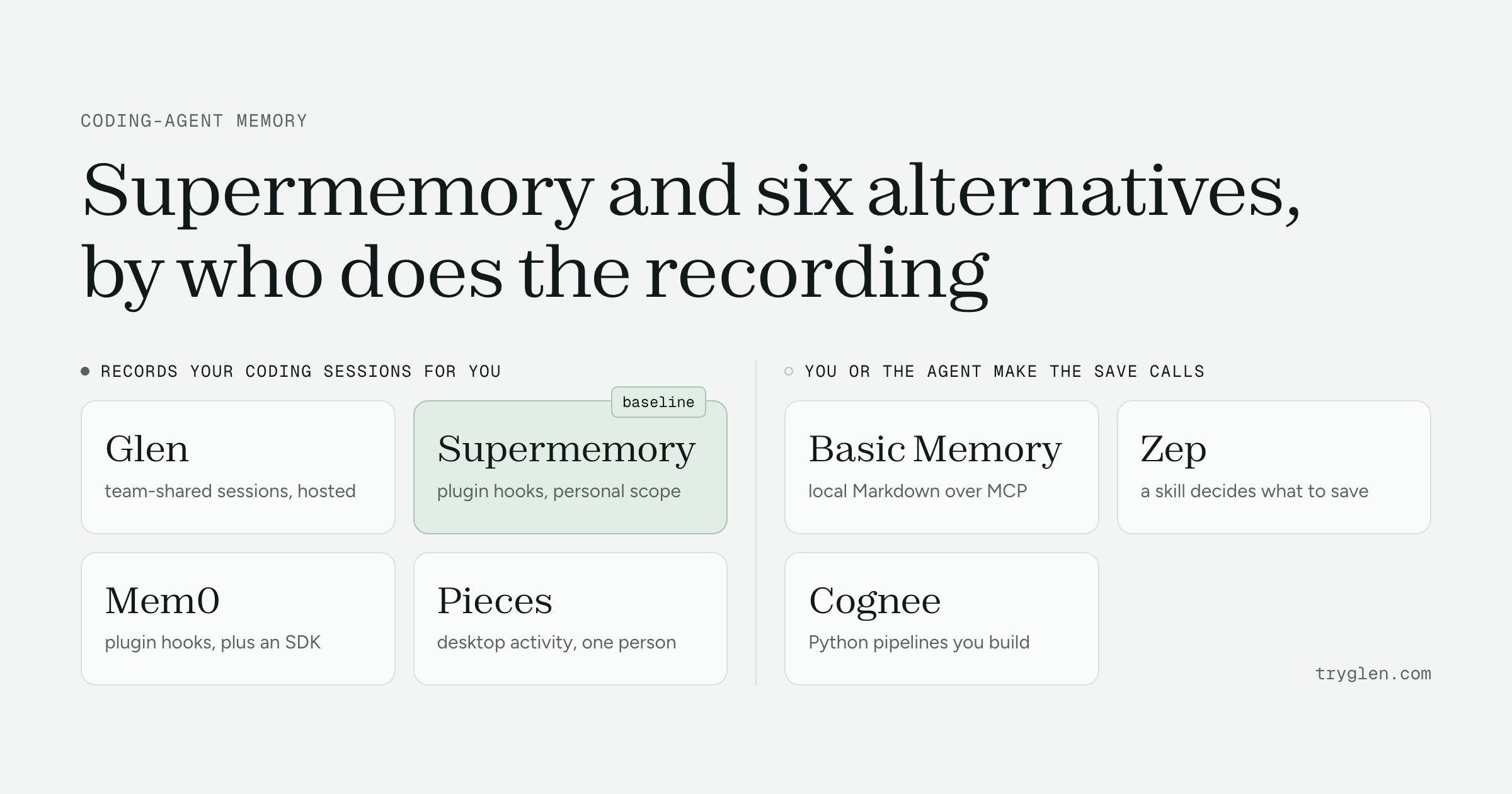
Supermemory is two products under one name: a memory API you build into an application, and plugins that give coding agents memory. Most people looking for an alternative want one of those and are paying, in setup or in seats, for the other.
This guide compares six alternatives for the coding-agent half: Glen, Basic Memory, Cognee, Mem0, Zep and Pieces. We make Glen, so read that section with that in mind. Prices and plan limits were read from each vendor's own pages in November 2026.
Short answer
- Your team's decisions live in coding-agent sessions and teammates need to find them: Glen records sessions from Claude Code, Codex, Cursor, Pi and Grok Build into one hosted workspace. It has no self-hosted build and no SDK.
- You're building memory into your own application: Mem0, Cognee and Zep are APIs and frameworks for that. Mem0 and Zep also have coding-agent plugins.
- You want personal recall across everything on your desktop: Pieces captures your own activity locally. It isn't built for shared team history.
- You want notes as plain files on your disk: Basic Memory stores Markdown and serves it over MCP.
- You want an application API and coding plugins from one vendor, or a free local binary: stay on Supermemory.
- You work alone in one agent:
AGENTS.mdand the agent's built-in memory probably cover it.
Why developers look beyond Supermemory
Supermemory's agents and MCP guide separates a docs-search MCP server from the Memory MCP and the coding plugins. The Codex plugin uses lifecycle hooks: it recalls context when you submit a substantive prompt and captures each completed turn in the background. For one developer that works well. Three things send teams looking elsewhere.
Automatic captures are personal. The Codex plugin files each captured turn in a container named after the repository's Git remote, and tags it with personal scope. An explicit save through MCP goes somewhere else: your account's active space. A team that wants every engineer's sessions searchable by every other engineer has to manage those scopes by hand.
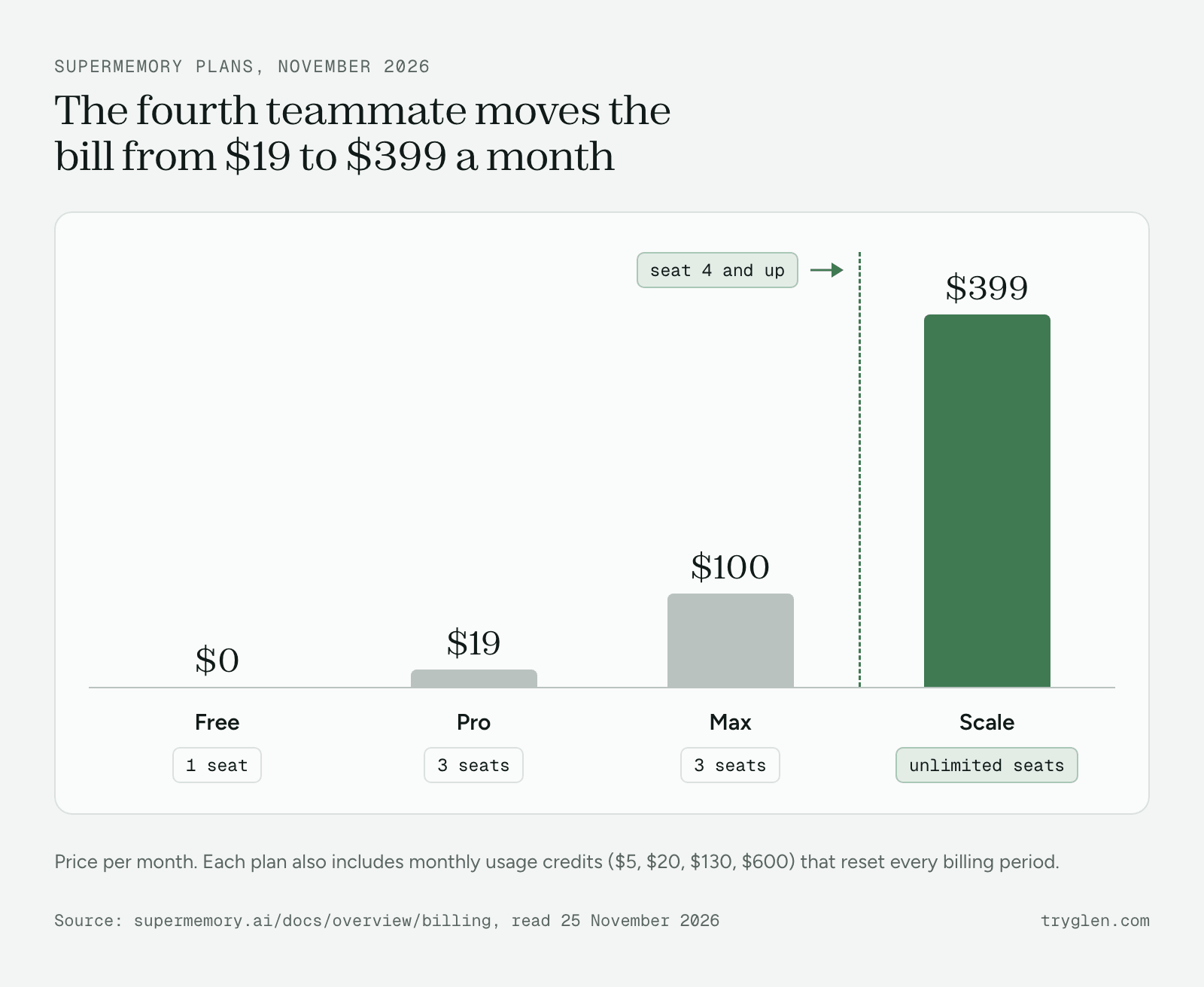
The fourth seat is expensive. Supermemory's billing page lists Free at one seat, Pro at $19 a month and Max at $100 a month with three seats each, and Scale at $399 a month with unlimited seats. A team of four pays for Scale. Each plan also includes usage credits that reset every billing period, and ingestion and queries draw them down. Coding plugins work on every plan, Free included.
Self-hosting is single-user. The local binary is free up to 10,000 stored documents under a lite license, runs with one auto-generated API key, and its server source isn't in the public repository. Member roles and scoped API keys need an Enterprise contract.
How to evaluate coding-agent memory tools
Memory products come in two kinds, and comparing across them wastes an afternoon. A coding-agent tool attaches to an agent you already run and records sessions with almost no setup. A memory framework gives you an SDK, and nothing is recorded until you write the code that calls it. Decide which you need first.
Then check capture and retrieval separately, because they're different connections.
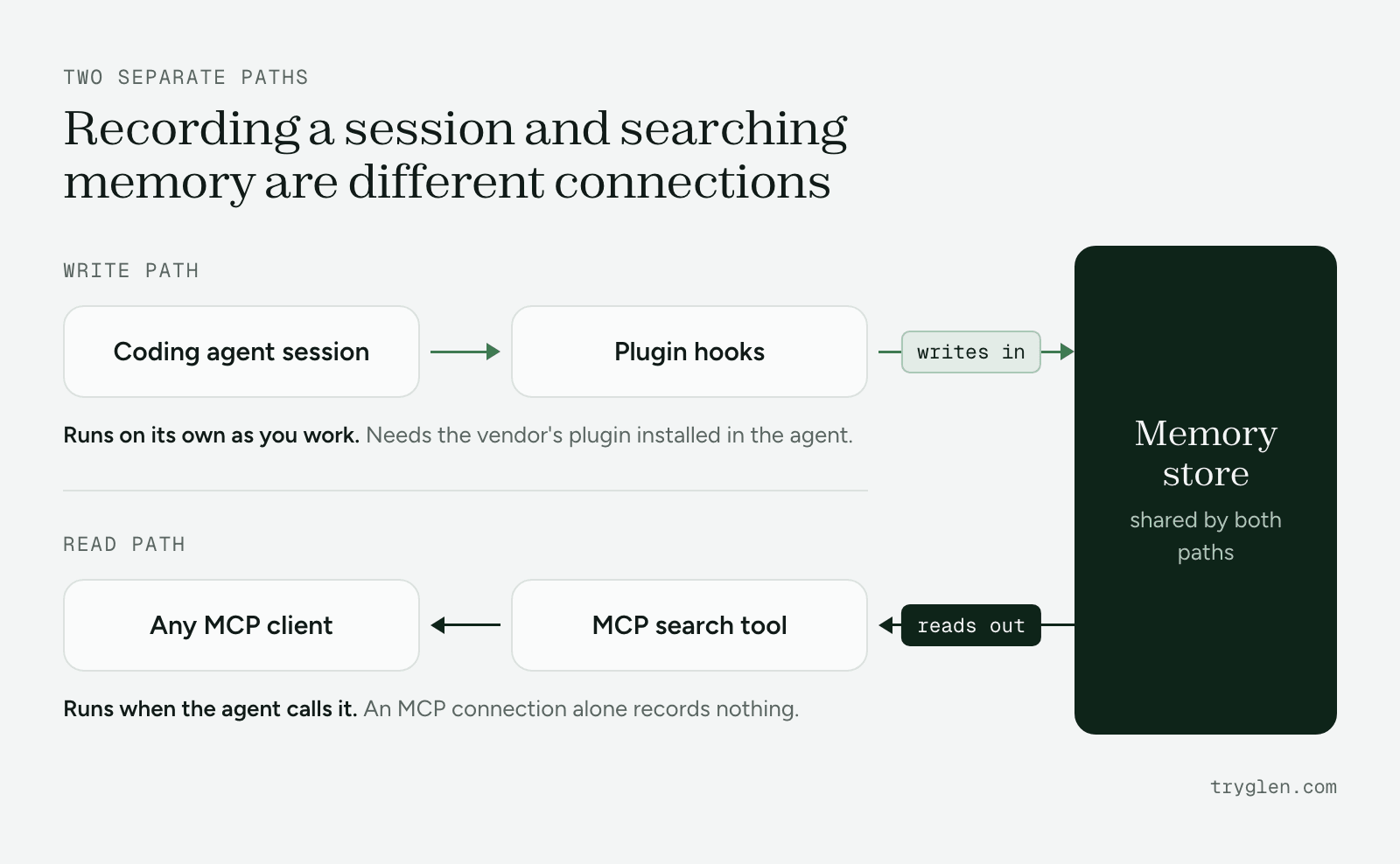
Capture is how context gets in. Plugin hooks record a session as it happens. An API records what your code sends. An MCP tool records only when the agent decides to call it, which means the reasoning in the middle of a long debugging session often never gets saved.
Retrieval is how context comes back. Some tools add matching memory to a prompt before the model sees it. Others wait for the agent to run a search. An MCP connection gives an agent a way to search, and by itself records nothing.
After those two, four practical questions decide the shortlist:
- Sharing: can a teammate search what your agent learned, and can you keep a session out?
- Deployment: hosted, on your machine, or in your own cloud?
- Setup: a plugin install, or an SDK integration you maintain?
- Pricing: by seat, by stored memory, or by usage?
Our five-test acceptance suite turns these into pass or fail checks you can run on your own repository.
Supermemory alternatives at a glance
| Tool | What it is | How context gets in | Team sharing | Runs where | Price |
|---|---|---|---|---|---|
| Supermemory (baseline) | App memory API plus coding plugins | Plugin hooks, MCP saves, API | Shared spaces; automatic captures are personal | Cloud, single-user local binary, Enterprise | Free, then $19 to $399 a month |
| Glen | Shared session memory for coding agents | Plugin hooks record every session | Whole workspace, with per-memory permissions | Hosted only | Free to 15,000 memories and 3 people, then paid plans |
| Basic Memory | Local Markdown notes over MCP | The agent calls a write tool, or you edit files | Git or file sync; paid cloud workspaces | Local, optional cloud | Free locally; cloud from $19 a month |
| Cognee | Open-source Python memory framework | Pipelines you write | You build it | Self-hosted or Cognee Cloud | Free library; cloud from $0 plus usage |
| Mem0 | App memory API plus coding plugins | Plugin hooks, API, MCP | Shared project memory per repository | Cloud, self-hosted, on-prem by contract | Free with quotas, then custom |
| Zep | Governed context layer with an MCP server | A skill tells the agent when to save | Personal graph plus authorized shared graphs | Cloud; VPC on Enterprise | Free, $125 or $375 a month, Enterprise |
| Pieces | Personal work memory across desktop apps | Local background capture | Personal; org policy controls | Local, optional cloud | $18.99 to $22.99 per user a month |
Six Supermemory alternatives for coding agents
Glen
Glen is the option to look at when the thing you're missing is your teammates' sessions. Plugins for Claude Code, Codex, Cursor, Pi and Grok Build record each session through hooks, with no save call from you or the agent. On day one you can import your last 30 days of sessions. Everything lands in one hosted workspace that every teammate's agent can search, and each answer cites the session, pull request or thread it came from.
Recall depends on the agent. In Claude Code, Codex and Pi, a hook checks each prompt and flags matching memory to the model. In Cursor and Grok Build, the agent runs glen search when it needs to. Other MCP clients, including Claude and ChatGPT, can search the same memory through the remote MCP server but record nothing. The per-agent setup guide lists what each plugin captures.
Here is the handoff this is built for. A teammate debugging a webhook timeout in Claude Code chooses idempotency keys over a retry queue. Weeks later you open the same handler in Cursor and ask why it doesn't retry. The agent searches Glen and gets that decision back, with a link to the session where it was made.
Controls: glen incognito keeps a session out of team memory, glen silent records without recalling, and glen forget hides a memory from search until you restore it. Paid plans connect Slack, GitHub and Linear. Slack is limited to public channels.
What you give up: there's no self-hosted build and no SDK or API for embedding memory in your own product. Teammates can find each other's recorded sessions, which rules Glen out if your policy forbids that. Search answers are generated, so follow the citation before acting on one. And if you work alone in one agent, you likely don't need it.
Pricing: free up to 15,000 memories and three people, no credit card. The Personal plan raises the limit to 250,000 memories and adds integrations. The Team plan removes the limits on people and memories.
Basic Memory
Everything Basic Memory knows is a Markdown file on your disk. A local SQLite index tracks the links between files, and MCP tools let an agent search notes and write new ones. You can open the same folder in Obsidian or commit it to Git. The local package is open source under AGPL-3.0.
It fits a solo developer who wants to read and edit their agent's memory as text.
What you give up: nothing is recorded unless the agent calls a write tool or you edit a file, so a long session can end with its reasoning unsaved. Sharing a local install with a team means syncing a folder through Git, with no permissions.
Pricing: free to run locally. Basic Memory Cloud is $19 a month per workspace, with Pro at $99 and Business at $249.
Cognee
Cognee is a Python framework for building a memory pipeline, and it expects you to write code. You feed it files and transcripts, an LLM extracts linked facts, and the results go into a knowledge graph and a vector index that you host. You choose the model provider and the databases. The library is open source under Apache-2.0.
It fits a team that wants memory inside its own infrastructure and has engineers to maintain the pipeline.
What you give up: Cognee ships no recorder for coding sessions, so you build the capture step before any recall works. LLM extraction over incoming history adds latency and token cost that grow with volume. Sharing across teammates means writing your own permissions and project scoping.
Pricing: the library is free, and you pay for your own models and databases. Cognee Cloud has a $0 Standard tier with 100 million tokens included and $0.10 per million after, a $99 a month Premium tier plus usage, and Enterprise deployment in your own cloud.
Mem0
Mem0 is the closest like-for-like to Supermemory: a memory API for applications, plus plugins for coding agents. For an application you embed the Python or Node.js SDK and call it yourself. For coding agents, the Codex plugin needs a Mem0 Platform key and Python 3.10 or newer, and the Claude Code plugin captures your messages, Claude's answers, changed files and test or build results.
Its scoping is cleaner than Supermemory's for a team. In the Claude Code plugin, project memory never carries a user ID, so everyone on the repository shares one pool, and personal preferences stay under your own ID.
What you give up: the hooks run locally but captured sessions go to Mem0's servers for extraction. Automatic recall in the Codex plugin runs on the first prompt only, and only when that prompt has at least 20 characters. After that the agent has to search. Mem0 stores extracted facts, not transcripts, so you can't open the session a fact came from.
Pricing: Mem0's pricing page lists two tiers. Free covers unlimited end users with 10,000 adds and 1,000 retrievals a month for the first 30 days, model calls included. After that you supply your own LLM key and get 50,000 adds and 10,000 retrievals a month. Usage past the limits is billed up to a monthly cap you set. Custom plans add graph memory, SSO, audit logs, an SLA and on-prem deployment. For the longer comparison, see Glen vs Mem0.
Zep
Zep is built for an organization that wants one governed store of context across all its agents, with an identity provider deciding who reads what. Its Context MCP Server connects Claude, ChatGPT, Claude Code, Codex and Cursor to each user's own graph and to shared graphs they're authorized for. A skill installed with the plugin tells the assistant when to search and when to save a durable fact.
That means Zep stores curated facts, not session transcripts. Administrators can restrict shared graphs or turn off writes for the whole account, and Enterprise plans run in Zep's cloud with your encryption keys or inside your VPC.
What you give up: an administrator has to connect identity and distribute the plugin before any sharing works, which is heavy for a small team. What gets remembered depends on the skill triggering a save. Self-serve plans are cloud only.
Pricing: Zep's pricing charges one credit per 350 bytes of ingested episode data, and limits Context MCP seats per plan. Free includes 10,000 credits a month, two projects and one MCP seat. Flex is $125 a month for 50,000 credits and five seats. Flex Plus is $375 a month for 200,000 credits and 15 seats.
Pieces
Pieces records your own working day. PiecesOS is a background service on your machine that captures activity across desktop apps into a Long-Term Memory, and acts as the MCP host that lets Cursor, VS Code, Claude and ChatGPT query it. Storage is local by default. Choosing a cloud model or an external MCP client sends data off the machine.
It fits one person who wants "what was I doing on Tuesday" answered across every app, not only the coding agent.
What you give up: the memory is personal. Pieces' organization documentation covers admin policy over each person's capture, and doesn't describe teammates searching each other's history. The same documentation carries a notice that individual plugin support has been sunset in favour of MCP and the CLI.
Pricing: no free tier. A 7-day trial requires a card. Pro is $18.99 per user a month, with 25% off yearly, and Enterprise is $22.99 per user a month.
When to keep Supermemory, or use neither
Keep Supermemory if you need an embeddable memory API and coding-agent plugins from one vendor. Splitting them across two tools is extra integration work for no gain. Keep it too if a free local binary on one machine matters more to you than shared team history: it processes text offline when paired with local models, and the Codex plugin works against either the local server or a hosted workspace.
Use no memory service at all if you work alone in one agent. AGENTS.md loads into every session, so your formatting rules and test commands apply every time. The agent's built-in memory keeps your preferences and corrections. A separate service is one more thing to maintain when your project's history never leaves one tool.
The line between the two is easiest to see with an example. Your AGENTS.md says every payment endpoint requires an idempotency key, and every session enforces it. Six weeks later a teammate asks why the checkout service retries failed webhooks with exponential backoff and has no dead-letter queue. That debate doesn't belong in AGENTS.md, where it would load into every unrelated task. It belongs somewhere searchable, so it comes up when someone works on webhooks and stays out of the way otherwise.
Add a memory tool when your context outgrows one developer or one agent. For teammates across several coding agents who need the reasoning from past sessions, Glen sits beside AGENTS.md and needs no integration code. For memory inside a product you're building, Mem0 or Zep is the better fit. Our comparison of seven memory tools covers the application-infrastructure side in more depth, and the Glen vs Supermemory page puts the two side by side.
Frequently asked questions
Does an MCP connection record coding sessions?
No. MCP lets an agent call a search or save tool when it chooses to. Automatic recording needs hooks inside the agent. Glen's plugins record through hooks, and its MCP server only searches. Supermemory splits the same way: the Codex plugin captures turns through hooks, and its Memory MCP handles explicit lookups and saves.
Do memory tools replace AGENTS.md?
No. Rules that must apply on every turn stay in AGENTS.md, because recall from a memory tool depends on a search or a match and isn't guaranteed on every prompt. Memory tools hold the reasoning behind past changes. The three context sources compared goes through which one answers which question.
Which Supermemory alternatives can be self-hosted?
Basic Memory (AGPL-3.0) and Cognee (Apache-2.0) are open source and run on your own hardware. Pieces runs locally by default. Mem0 has an open-source library and a self-hosted server. Zep keeps private-cloud deployment for Enterprise contracts. Supermemory's local binary is free for one machine up to 10,000 documents. Glen is hosted only.
What is the difference between a memory API and coding-agent memory?
A memory API is a library you call from software you're building: your code decides what to store and when to query. Coding-agent memory plugs into an agent you already use and records sessions through hooks, with no code from you. Supermemory and Mem0 offer both. Glen offers only the second.
How much does Supermemory cost for a team of five?
$399 a month on the Scale plan, the first plan with more than three seats, plus any usage beyond its included credits. Pro at $19 and Max at $100 both stop at three members.