Updated
The best memory for Goose in 2026
The best memory for goose is Glen if you're on a team whose other agents and tools already record into it, and goose's own Memory extension plus .goosehints if you work alone. There is no Glen extension built for goose. Glen connects as a remote MCP server, added as a Streamable HTTP extension with OAuth sign-in, so a goose agent can search what teammates' Claude Code, Codex and Cursor sessions recorded, along with Slack, GitHub, tickets, docs and calls. goose sessions themselves are not recorded into Glen.
goose, the open-source agent that started at Block and is now part of the Agentic AI Foundation at the Linux Foundation, ships three memory layers of its own. The Memory extension saves what you ask it to remember as files under .goose/memory/ in the project or ~/.config/goose/memory/ for every project, and the docs say all of them load at session start. AGENTS.md and .goosehints carry written instructions. Every session, from the desktop app or the CLI, is kept in a local SQLite database that the Chat Recall extension can search. We compared six options on what they record from goose, what a goose agent can recall through them, and who else can read it.
Short answer
- A team whose memory already comes from Claude Code, Codex, Cursor, Slack and GitHub
- Glen
- Solo, preferences and project rules with nothing extra installed
- goose Memory extension + .goosehints
- Solo, entities and the relations between them, free and local
- Knowledge Graph Memory
- Recall of work done outside the terminal, kept on your machine
- Pieces
- Searching history that Claude Code, Codex or Cursor recorded locally
- claude-mem
Goose memory tools at a glance
| # | Tool | Connects via | Captures | Team sharing | Price |
|---|---|---|---|---|---|
| 01 |  GlenOur pick | Remote MCP extension (Streamable HTTP, OAuth) | goose sessions not recorded; reads team memory | Whole orgOrg-wide, filtered per user at recall | Free for 15,000 memories, no card |
| 02 |  goose Memory extension + .goosehintsgoose-docs.ai | Built in | When you tell goose to remember; sessions saved locally | Repo filesAGENTS.md and .goosehints through git; sessions stay on one machine | Free |
| 03 |  Knowledge Graph Memorygithub.com | Command-line (stdio) extension from goose's extension directory | When the agent calls its tools | One personOne JSONL file on your machine | Free, runs locally |
| 04 |  Piecespieces.app | Command-line (stdio) extension from goose's extension directory | Screen, clipboard and audio, captured by PiecesOS | One personPer user, stored locally | Pro $18.99/user/mo, no free plan |
| 05 |  claude-memcmem.ai | Stdio MCP extension added by its installer | goose sessions not recorded; search only | One personLocal to one machine; TeamBrain is a pilot | Free locally; CMEM Pro $30/mo |
| 06 |  Supermemorysupermemory.ai | Remote MCP extension (Streamable HTTP, OAuth); generic setup | When the agent calls add_memory | Shared spacesSpaces that teammates are granted read or write access to | Free with $5 credit; Pro $19/mo |
How we ranked them
- Records goose sessions. goose saves its own sessions locally. None of the outside tools here records a goose session through goose itself, so we say what each one stores and what triggers the save, Glen included.
- What the agent can recall. Some picks give goose only what goose was told to keep. Others reach what other agents recorded, or what a team wrote in Slack and GitHub.
- Recall timing. goose's Memory extension puts saved memories in every prompt. An MCP tool is called when the agent decides to call it, so a line in .goosehints or AGENTS.md saying when to search matters.
- Who can read it. Whether a stored fact stays on one machine, travels through git, or is shared across an org, and what decides who sees it.
- Setup and price. What goes under extensions in ~/.config/goose/config.yaml, and the first paid tier from each vendor's pricing page as of November 2026.
The 6 best memory tools for Goose
Glen
Our pickBest for: goose users on teams whose other agents and tools already feed Glen.

tryglen.com - Connects to Goose
- Remote MCP extension (Streamable HTTP, OAuth)
- Captures
- goose sessions not recorded; reads team memory
- Shared with your team
- Org-wide, filtered per user at recall
No Glen extension exists for goose. You add Glen's MCP server, https://mcp.tryglen.com/mcp, as a Streamable HTTP extension and sign in with OAuth in the browser; goose's docs say remote extensions that need OAuth obtain a client ID automatically, through Client ID Metadata Documents or Dynamic Client Registration. The agent then calls glen_search, glen_code_search, glen_skill_search and glen_artifact_search when it decides a question needs them. Nothing is added to a prompt ahead of time, and goose sessions are not recorded into Glen.
What the search reaches is the reason to add it. Teammates' Claude Code, Codex and Cursor sessions are recorded through Glen's plugins, and public Slack channels, GitHub, tickets, docs and call transcripts from Fireflies, Fathom and Granola come in through integrations one person sets up once. Results are filtered per observation to what the signed-in user is cleared to see, and a decision the team has reversed stops surfacing. Because goose's Developer extension can run shell commands, a machine with the glen CLI installed has a second route to the same memory: glen search "<question>". If you work alone and goose is your only agent, Glen has little to recall for you; start with goose's own Memory extension below.
Strengths
- Reads memory recorded from the team's Claude Code, Codex and Cursor sessions
- Slack, GitHub, tickets, docs and calls in the same search
- OAuth sign-in with no API key in config.yaml and nothing to run locally
- glen_code_search traces a line of code to the recorded session that wrote it
Limits
- goose sessions are not recorded into memory
- Recall happens only when the agent calls glen_search
- Hosted only; there is no self-hosted build
Managed service · Free for 15,000 memories, no card
Set up Glen in Goose →goose Memory extension + .goosehints
Best for: One developer who wants goose to keep preferences and project rules with nothing else installed.
goose-docs.ai - Connects to Goose
- Built in
- Captures
- When you tell goose to remember; sessions saved locally
- Shared with your team
- AGENTS.md and .goosehints through git; sessions stay on one machine
Three separate parts of goose do the remembering. The Memory extension ships with goose but stays off until you enable it, from Extensions in goose Desktop or with goose configure. It gives goose four tools (remember_memory, retrieve_memories, remove_memory_category and remove_specific_memory) and stores each memory with a category and optional tags as a file, under .goose/memory/ in the working directory for one project or ~/.config/goose/memory/ for all of them. It saves when you say so, with "remember", "save" and "forget" among the documented trigger words, or when goose suggests saving and you agree. Per the docs, goose loads all saved memories at the start of a session and includes them in every prompt, so a long memory costs tokens on each request.
Context files are the second part. goose looks for AGENTS.md and then .goosehints at each level from the working directory up to the repository root, reads ~/.config/goose/.goosehints for global rules, and loads nested files as it touches subdirectories. The CONTEXT_FILE_NAMES variable adds CLAUDE.md or .cursorrules. Hints load only while the Developer extension is enabled.
The third is history. Sessions from goose Desktop and the CLI go into one SQLite database at ~/.local/share/goose/sessions/sessions.db, and Chat Recall, a platform extension that is also off by default, lets goose search that history by keyword and load summaries of specific sessions. Recipes package prompts, extensions and settings into a file or link for a teammate, but each recipient gets a private session, so a recipe shares a workflow and no memory.
Strengths
- Free and part of goose
- Memories are files on disk, split into project and global scope
- Chat Recall searches sessions from both Desktop and the CLI
- Reads AGENTS.md by default, and CLAUDE.md through CONTEXT_FILE_NAMES
Limits
- The Memory extension keeps only what you ask it to, or approve
- Session history and global memories stay on one machine
- Every saved memory is sent with every prompt
Built into goose (Apache 2.0) · Free
Visit goose-docs.ai ↗Knowledge Graph Memory
Best for: Solo developers who want goose to keep entities and how they relate, locally and for free.
github.com - Connects to Goose
- Command-line (stdio) extension from goose's extension directory
- Captures
- When the agent calls its tools
- Shared with your team
- One JSONL file on your machine
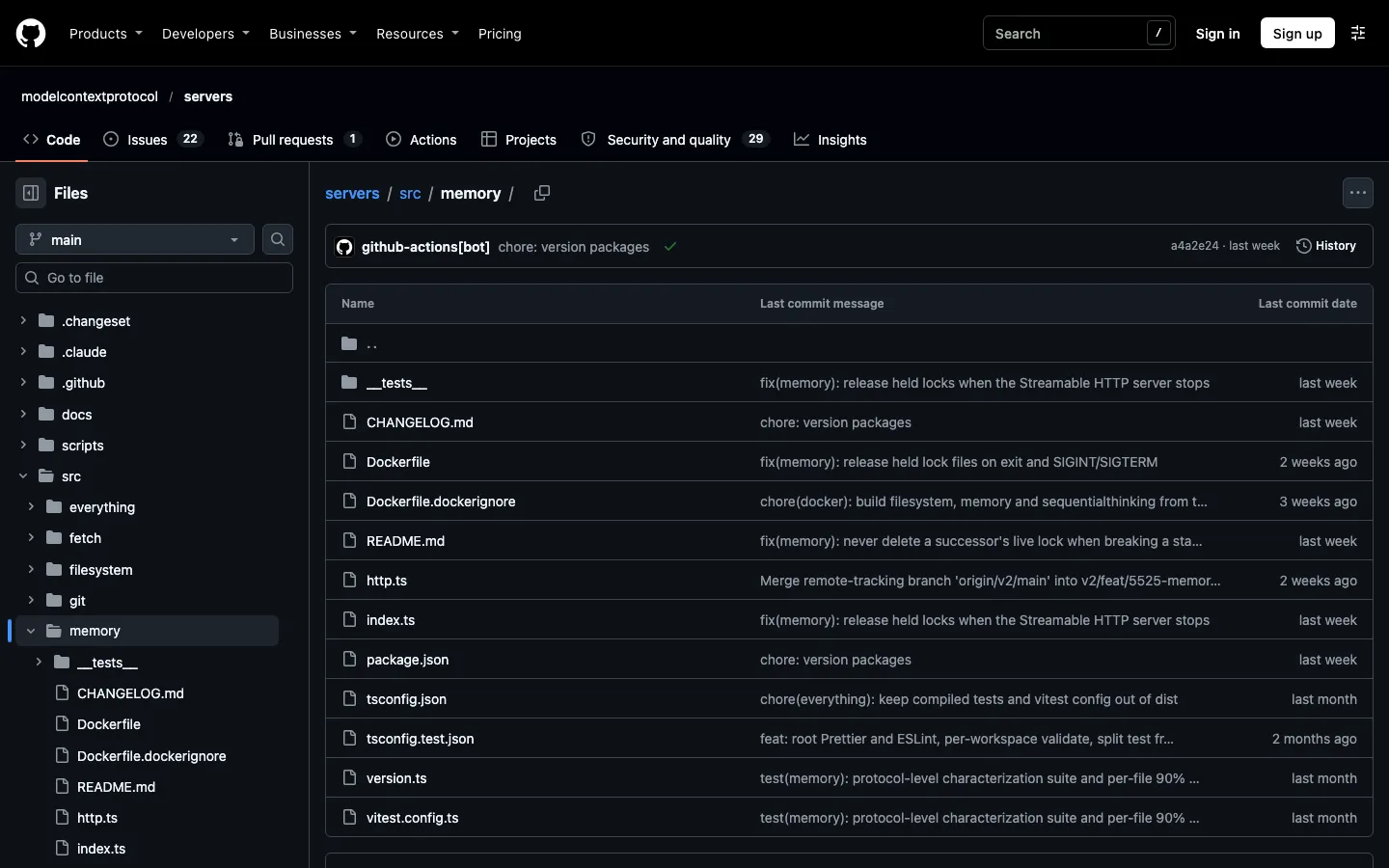
goose's docs use this server as the worked example for adding an extension, and it has both a tutorial and an entry in the extension directory with a one-click installer for goose Desktop. It is the MCP project's reference memory server, published as @modelcontextprotocol/server-memory and started with npx -y @modelcontextprotocol/server-memory. Where goose's built-in Memory extension keeps categorized notes, this one stores entities, typed relations between them and observations attached to each entity. The agent writes with create_entities, create_relations and add_observations, and reads back with search_nodes, open_nodes or read_graph.
Everything sits in one JSONL file. By default that file lives in the server's own directory, which under npx is inside a node_modules tree that an npx cache clear can delete, so the README tells you to set MEMORY_FILE_PATH to an absolute path you own. In goose that goes in the extension's environment variables. Nothing is captured unless the agent calls a tool, and there is no account or hosted service. The servers repository has about 92,000 GitHub stars; new code is Apache 2.0 and older code remains MIT.
Strengths
- Listed in goose's extension directory, with a tutorial in goose's docs
- Free, local, no account
- Stores relations between things, not only notes
Limits
- Saves only when the agent calls a tool
- The default storage path can be wiped by an npx cache clear
- One file on one machine, with no sharing
Open source (MIT) · Free, runs locally
Visit github.com ↗Pieces
Best for: Individuals who want recall of work done outside goose, stored on their own machine.
pieces.app - Connects to Goose
- Command-line (stdio) extension from goose's extension directory
- Captures
- Screen, clipboard and audio, captured by PiecesOS
- Shared with your team
- Per user, stored locally
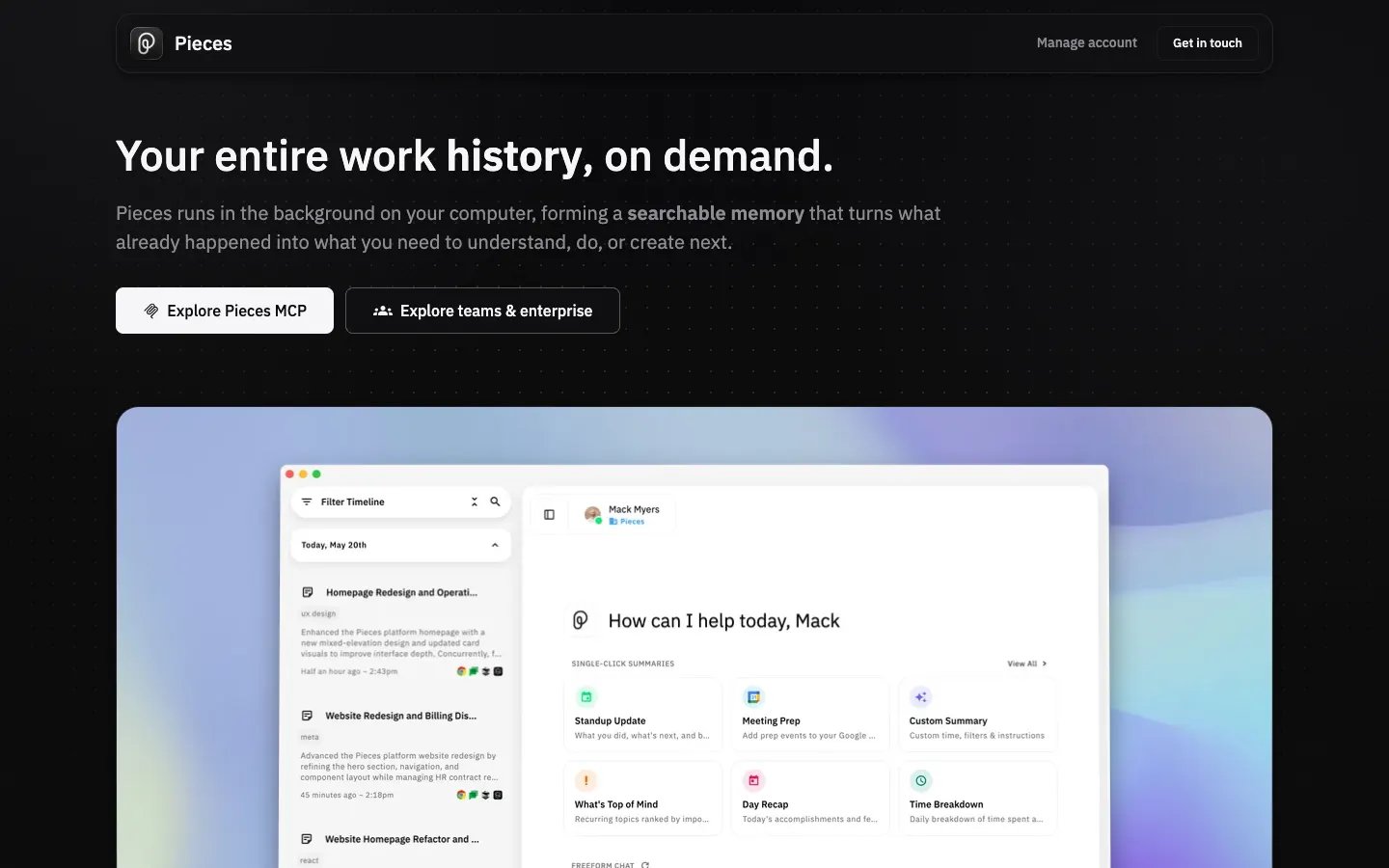
Capture happens outside the agent with Pieces. PiecesOS runs on your machine and its Long-Term Memory engine records workflow context as you work, which Pieces describes as code you copy, screens you view and audio you hear, all stored locally. goose reads that record through the Pieces MCP server and its ask_pieces_ltm tool. goose's docs carry a tutorial and a directory entry for it: the extension command is uvx --from pieces-cli pieces --ignore-onboarding mcp start, and PiecesOS has to be running with Long-Term Memory enabled.
Because nothing waits on goose deciding to save, Pieces holds context a hint file never would, such as the thread you read before you opened the terminal. It is one person's record and isn't shared with anyone. Pieces is proprietary. Pro costs $18.99 per user a month, there is no free plan, and the 7-day trial asks for a card. One caution: Pieces' own goose guide still gives an SSE endpoint, and goose's configuration docs say SSE is no longer supported, so follow the tutorial in goose's docs.
Strengths
- Captures without the agent calling a save tool
- Tutorial and directory entry in goose's own docs
- Data is stored locally
Limits
- No free plan
- Strictly one person's memory
- PiecesOS has to run alongside goose
Proprietary · Pro $18.99/user/mo, no free plan
Visit pieces.app ↗claude-mem
Best for: Developers who run Claude Code, Codex or Cursor next to goose and want goose to search that history.

cmem.ai - Connects to Goose
- Stdio MCP extension added by its installer
- Captures
- goose sessions not recorded; search only
- Shared with your team
- Local to one machine; TeamBrain is a pilot
About 120,000 GitHub stars make claude-mem the most-starred memory project on this page, and its README is direct about goose: goose can search your memory, but goose sessions aren't recorded. The installer detects goose and adds a claude-mem stdio extension under extensions in ~/.config/goose/config.yaml; npx claude-mem install --ide goose sets up that one agent. What goose then searches is the history claude-mem captured from the agents it does hook, Claude Code, Codex, Cursor and OpenCode among them, kept in ~/.claude-mem on your machine.
So in goose it is useful only if one of those other agents is also on your machine, writing the history goose reads. The engine is Apache 2.0 and free to run locally. Cloud Sync is $12 a month after a 30-day trial, and hosted model plans start at $30 a month. TeamBrain, its shared workspace for teams, has no public price and is offered as a pilot.
Strengths
- Free and local by default
- First-party installer writes the goose extension entry for you
- Gives goose the history recorded from Claude Code, Codex, Cursor and OpenCode
Limits
- Nothing you do in goose is recorded
- Memory stays on one machine unless you pay for Cloud Sync
- Team sharing is a pilot with no public price
Open source (Apache 2.0) · Free locally; CMEM Pro $30/mo
Visit cmem.ai ↗Supermemory
Best for: Teams already building on Supermemory's API who want goose reading the same store.
supermemory.ai - Connects to Goose
- Remote MCP extension (Streamable HTTP, OAuth); generic setup
- Captures
- When the agent calls add_memory
- Shared with your team
- Spaces that teammates are granted read or write access to
goose isn't named anywhere in Supermemory's setup docs. They give one remote MCP server, https://mcp.supermemory.ai/mcp, which signs in with OAuth and needs no API key, and tell clients without a dedicated guide to add it as a remote HTTP server. goose takes that URL as a Streamable HTTP extension, the same way it takes Glen's. Supermemory's install-mcp CLI also lists goose among its supported clients. Either way this is a generic MCP connection: the agent saves with add_memory and recalls with search_memory or get_profile when it chooses to, and nothing else from a goose session is captured.
Memory is organized into spaces, and teammates work in the spaces they are allowed to read or write. The product underneath is a hosted memory API, so a team building its own agent can point it at the same store. The core is MIT-licensed with about 32,000 GitHub stars. The free plan includes $5 of credits a month; Pro is $19 a month with three seats.
Strengths
- OAuth remote server, so nothing runs locally
- Spaces give a team shared memory with read and write grants
- One API for goose and your own product
Limits
- No goose-specific setup guide or plugin
- Saving waits for the agent to call add_memory
- Usage is metered in credits
Open source (MIT) · Free with $5 credit; Pro $19/mo
Visit supermemory.ai ↗
Set up Glen in Goose
Glen connects to goose as a remote extension over Streamable HTTP with OAuth sign-in, so there is no plugin to install. You need a Glen account; the free plan covers 15,000 memories with no card. goose reads team memory and does not write to it, so the memory fills from your team's other agents and integrations. On a machine that already has the glen CLI, goose's Developer extension can also run glen search from its shell tool.
1. Add Glen as a remote extension
Run goose configure, choose Add Extension, then Remote Extension (Streamable HTTP), name it glen, enter https://mcp.tryglen.com/mcp as the endpoint URI, and answer No to custom headers. In goose Desktop, open Extensions in the sidebar, click Add custom extension, set Type to Streamable HTTP and paste the same URL as the Endpoint. You can also write the entry by hand under extensions in ~/.config/goose/config.yaml.
yamlextensions: glen: type: streamable_http name: glen enabled: true uri: "https://mcp.tryglen.com/mcp" timeout: 3002. Sign in
Start a session. goose obtains an OAuth client ID from Glen automatically and opens a browser window for sign-in when the extension first connects, so no key or header goes in the config.
bashgoose session3. Tell the agent when to search
Recall happens when goose calls glen_search, so add a line to .goosehints or AGENTS.md at the repo root saying when to use it. Hints load while the Developer extension is enabled, which is the default. You can also ask directly, for example "search Glen for why we split the billing worker".
markdownBefore changing code you didn't write in this session, call glen_search for past decisions about it.
Which one should you pick?
A developer working alone can get a long way on what goose ships. Enable the Memory extension, keep AGENTS.md or .goosehints current, turn on Chat Recall, and you have saved facts, project rules and searchable session history for free. Add Knowledge Graph Memory if you want relations between things and not only notes, or Pieces if the context you keep losing sits outside the terminal. Apart from the files you commit, all of that stays on your machine.
Glen is the pick when the answer you need was worked out somewhere else: in a teammate's Claude Code or Codex session, a public Slack channel, a pull request review or a recorded call. goose searches all of it through one remote extension, filtered to what you're cleared to see, with reversed decisions left out. The limit is the one claude-mem has here too, which is that goose sessions don't write back. On a team where goose is the only agent anyone runs, Glen will return little until Slack, GitHub or another recorded agent is feeding it.
FAQ
- Does goose have memory?
- Yes, in three parts. The built-in Memory extension, off until you enable it, saves facts you ask goose to remember and loads them at the start of each session. AGENTS.md and .goosehints files hold written instructions. Every session is stored locally, and the Chat Recall extension lets goose search past sessions by keyword.
- Where does goose store memory?
- The Memory extension writes files to .goose/memory/ in your working directory for project memories and ~/.config/goose/memory/ for global ones. Global hints live in ~/.config/goose/.goosehints. Session history is a SQLite database at ~/.local/share/goose/sessions/sessions.db on macOS and Linux, and %APPDATA%\Block\goose\data\sessions\sessions.db on Windows.
- Does goose read AGENTS.md or CLAUDE.md?
- AGENTS.md, yes: by default goose looks for AGENTS.md and then .goosehints at each level from the working directory up to the repository root. CLAUDE.md is not read by default. Set the CONTEXT_FILE_NAMES environment variable to a JSON array such as ["CLAUDE.md", ".goosehints"] to add it.
- How do I add a remote MCP server to goose?
- Run goose configure, choose Add Extension, then Remote Extension (Streamable HTTP), and enter the endpoint URI. In goose Desktop, use Add custom extension with Type set to Streamable HTTP. In config.yaml the entry has type: streamable_http and a uri key. For one session only, pass --with-streamable-http-extension <url> to goose session. goose handles OAuth for remote extensions; SSE servers are no longer supported.
- Does Glen record my goose sessions?
- No. Glen has no extension built for goose. It connects as a remote MCP server, so the agent can search team memory but goose sessions aren't recorded. The memory it reads comes from teammates' Claude Code, Codex and Cursor sessions and from Slack, GitHub, tickets, docs and calls.
- Can goose share memory with a team?
- Written instructions, yes: an AGENTS.md or .goosehints file committed to the repo reaches everyone who clones it. Recipes share a workflow by link or file, but each person gets a private session. Session history and global memories stay on one machine. For memory a team shares, goose has to connect to an outside store over MCP, such as Glen or Supermemory.